Oleaginous Yeasts: The Overlooked Microbial Feedstock Powering the Next Generation of Sustainable Fuels
While microalgae often take centre stage in discussions on renewable biofuels, another remarkable group of microorganisms is quietly emerging as a powerful contributor to the future of sustainable energy: oleaginous yeasts. These naturally occurring lipid-producing microorganisms combine rapid growth, high oil productivity and the ability to utilise a wide variety of renewable carbon sources, making them an increasingly attractive feedstock for advanced biofuel production.
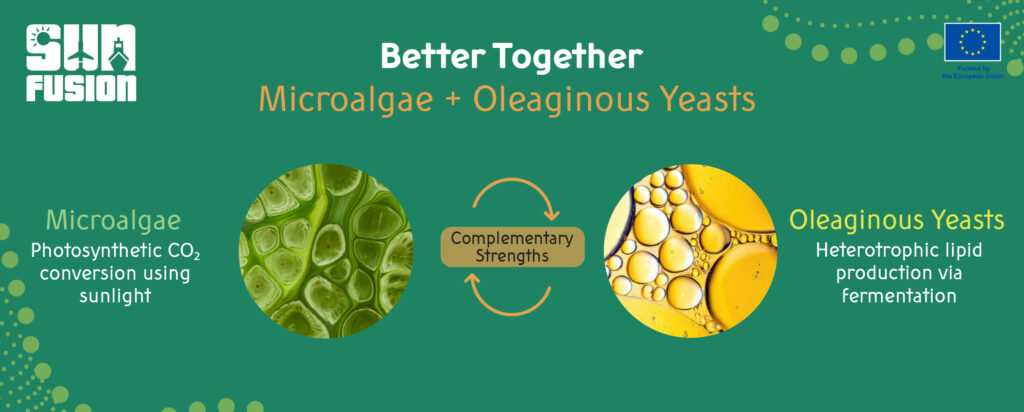
At SUNFUSION, oleaginous yeasts are not considered an alternative to microalgae but rather a complementary microbial platform. By integrating both feedstocks into a solar-powered biorefinery, the project aims to demonstrate innovative pathways for producing sustainable aviation and marine fuels while maximising resource efficiency.
What Are Oleaginous Yeasts?
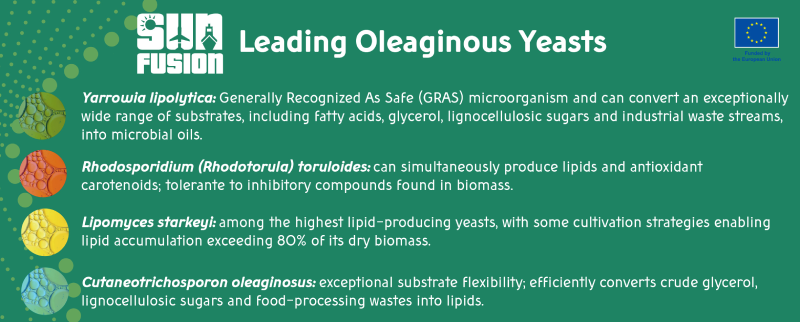
Oleaginous yeasts are a unique group of heterotrophic microorganisms capable of converting renewable carbon sources into oils known as single-cell oils (SCOs). Under nutrient-limited conditions, they redirect cellular metabolism towards lipid biosynthesis, enabling them to accumulate lipids exceeding 20% of their dry biomass, while some species can store up to 60-70% of their cell weight as oils. Although more than 1,500 yeast species have been identified, only around 30 possess this remarkable lipid-producing ability.
The oils produced by oleaginous yeasts are rich in C16 and C18 fatty acids, giving them a composition similar to conventional vegetable oils. This makes them attractive renewable feedstocks for the production of hydroprocessed biofuels, including renewable diesel and sustainable aviation fuel (SAF).
Another key advantage of oleaginous yeasts is their exceptional metabolic versatility. They can efficiently grow on a wide range of renewable and low-cost substrates, including agricultural residues, lignocellulosic hydrolysates, crude glycerol from biodiesel production, and other industrial side streams. Together with their rapid growth and compatibility with established fermentation technologies, these characteristics position oleaginous yeasts as highly promising microorganisms for future integrated biorefineries.
Why Are Scientists Paying More Attention to Oleaginous Yeasts?
Interest in oleaginous yeasts has increased dramatically over the past few years as researchers seek feedstocks that avoid competition with food production while offering high productivity.
Compared with terrestrial oil crops, yeasts provide several important advantages:
- rapid growth rates measured in hours rather than months;
- cultivation independent of climate and arable land;
- year-round production in controlled bioreactors;
efficient conversion of renewable carbon into lipids; - compatibility with industrial fermentation technologies already established at commercial scale.
Unlike seasonal crops, microbial cultivation enables continuous biomass production, improving process stability and supply chain resilience.
From Microbial Oils to Sustainable Aviation Fuel
The lipids accumulated by oleaginous yeasts are not the final product; they represent an intermediate renewable resource that can be transformed into advanced fuels.
Within SUNFUSION, microbial biomass from both microalgae and yeasts is converted through continuous hydrothermal liquefaction (HTL), a thermochemical process that directly processes wet biomass without the energy-intensive drying required by many conventional biofuel pathways. The resulting biocrude is subsequently upgraded through hydrotreatment to produce advanced sustainable aviation and marine fuels.
This integrated approach combines renewable biomass with concentrated solar thermal energy and thermal energy storage to reduce fossil energy demand throughout the conversion process.
Looking Beyond Biofuels
One of the most exciting developments in recent research is the growing emphasis on microbial biorefineries. Instead of producing only fuels, future facilities may valorise every fraction of the microbial biomass.
Potential co-products include:
- high-value proteins for feed applications;
- carotenoids and other natural pigments;
- specialty lipids;
- biopolymers;
- platform chemicals;
- nutrients recovered from process streams.
Producing multiple products alongside fuels improves resource efficiency and strengthens the economic viability of microbial biorefineries.
Current Challenges
Although progress has been remarkable, several challenges remain before oleaginous yeasts achieve widespread commercial deployment.
Researchers continue to work on:
- reducing cultivation costs;
- improving lipid productivity;
- optimizing renewable feedstocks;
- increasing tolerance to industrial operating conditions;
- integrating fermentation with downstream fuel production.
Advances in metabolic engineering, systems biology, process optimisation and artificial intelligence are accelerating progress across each of these areas.
SUNFUSION: Integrating Microalgae, Oleaginous Yeasts and Solar Technologies
SUNFUSION recognises that the future of renewable fuels will not rely on a single technology or a single feedstock. Instead, the project brings together complementary biological and engineering innovations into one integrated system.
By combining microalgae and oleaginous yeasts, concentrated solar thermal energy, thermal energy storage, continuous hydrothermal liquefaction and fuel upgrading, SUNFUSION is developing an innovative pathway towards advanced sustainable aviation and marine fuels. The project also aims to recycle gaseous and aqueous process streams back into cultivation, supporting a circular, zero-emission and zero-waste production concept while evaluating the technology from technical, environmental and economic perspectives.
Follow our Newsroom for more updates.
References:
- Adrio, J. L. (2017). Oleaginous yeasts: promising platforms for the production of oleochemicals and biofuels. Biotechnology and bioengineering, 114(9), 1915-1920.
- Abeln, F., & Chuck, C. J. (2021). The history, state of the art and future prospects for oleaginous yeast research. Microbial cell factories, 20(1), 221.
- Caporusso, A., Capece, A., & De Bari, I. (2021). Oleaginous yeasts as cell factories for the sustainable production of microbial lipids by the valorization of agri-food wastes. Fermentation, 7(2), 50. https://doi.org/10.3390/fermentation7020050