From Concept to Integration: Modelling SUNFUSION’s Solar-Powered Microalgae-to-Biocrude Pathway

Over the past months, the SUNFUSION Newsroom has explored some of the key technologies behind the project’s vision. We have looked at how hydrothermal processing can convert high-moisture biomass without an energy-intensive drying step, and how concentrated solar technologies can provide renewable heat for this process. More recently, we explored the role of Thermal Energy Storage (TES) in overcoming solar intermittency and supporting stable operation of renewable-energy-driven processes.
But what happens when these technologies are brought together?
This is where the latest work of SUNFUSION partners CERTH and the Laboratory of Biochemical and Biotechnological Processes (LB2P) at Aristotle University of Thessaloniki (AUTH) takes the story one step further.
Their recent research, submitted to EUBCE 2026 under the title “A Model-based Approach of combined Microalgae Cultivation and Hydrothermal Liquefaction Processes supported with CSP,” investigates how microalgae cultivation, biomass harvesting and processing, hydrothermal liquefaction (HTL), concentrated solar energy, and resource recovery can operate as parts of one integrated system. In other words, the focus is shifting from understanding the individual building blocks to understanding how they work together.
From Individual Technologies to an Integrated System
One of the central ideas behind SUNFUSION is that developing sustainable fuels is not simply about improving one conversion technology. The way biomass is produced, harvested, and processed, how energy is supplied to the conversion process, and how water, carbon, and other process streams are recovered all influence the performance of the overall system.
The CERTH-AUTH team is therefore developing a model-based approach for the integrated design and simulation of microalgae cultivation coupled with solar-aided HTL for biocrude production.
The model is designed to evaluate alternative process configurations, identify important integration challenges and explore potential synergies among the different subsystems. In line with SUNFUSION’s broader ambitions, the approach incorporates the principles of resource efficiency, renewable energy integration and movement towards zero-waste operation. This represents an important progression in the SUNFUSION research story: from understanding the individual technological building blocks to investigating how they interact when brought together within one system.
Starting with Microalgae
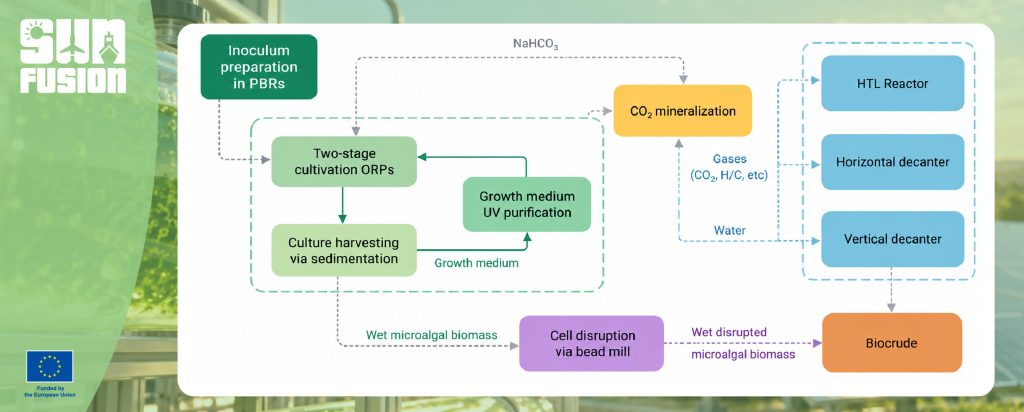
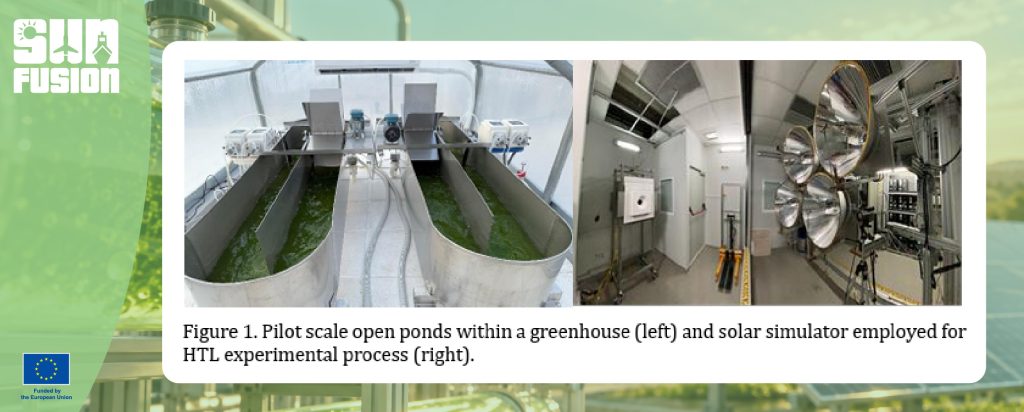
The process-flow starts from the microalgae cultivation step. The work focuses on Tetradesmus obliquus CCAP 276/10, selected as the primary feedstock based on characteristics including its rapid growth, resilience under variable cultivation conditions and ability to overaccumulate lipids under multiple stress conditions. The microalgal biomass is produced in pilot-scale open raceway ponds, providing controlled cultivation conditions while maintaining exposure to natural sunlight. The proposed process continues beyond biomass production, where microalgae are continuously collected and harvested through sedimentation, while the recovered aqueous stream is treated using UV and filtration before being recycled into the ponds. This creates an opportunity to conserve water and reduce external resource requirements.
Prior to the HTL process, the researchers are also exploring a potential cell-wall disruption step using bead milling, after which either disrupted or untreated wet biomass can enter the conversion process.
Why HTL Fits the Microalgae Pathway
As introduced in our previous article on solar-powered hydrothermal processing, one important characteristic of HTL is its ability to process wet biomass without requiring the energy-intensive step of drying. This makes the technology particularly relevant for microalgae processing.
Under elevated temperature and pressure, wet biomass is thermochemically converted into an energy-dense biocrude that can subsequently be upgraded towards transportation fuels. In the wider SUNFUSION concept, this pathway contributes to the project’s ambition to develop renewable alternatives targeting aviation and marine fuels.
The new CERTH-AUTH work goes beyond considering HTL as an isolated conversion step. Instead, the researchers are investigating its energy requirements and its interdependencies with upstream microalgae cultivation and processing.
Bringing Solar Energy Directly into the Process
HTL requires substantial thermal energy, making the source of process heat an important part of the overall sustainability equation. A key feature of the proposed approach is therefore the integration of concentrated solar technologies (CST) as the primary heat source for the HTL reactor. Following the pilot-scale cultivation of T. obliquus, experimental HTL trials were conducted using a laboratory-scale solar simulator. These preliminary experiments provided proof of concept, aided towards the stabilization of the operating conditions and generated empirical data that can support model calibration and validation.
The preliminary modelling results are encouraging. Depending on the operating scenario, the analysis indicates that the thermal energy requirements of HTL could be satisfied through direct solar-assisted heating, while a heat supply exceeding 10% of the overall plant heating needs can be provided by renewable sources in the preliminary computational scenarios considered. Importantly, this type of energy mapping does more than estimate energy demand. It can provide information for preliminary equipment sizing, heat recovery optimisation and operational scheduling as the integrated SUNFUSION biorefinery concept develops further.
Where Thermal Energy Storage Enters the Picture
Solar energy, however, comes with an inherent challenge: availability changes over time, while industrial processes require reliable energy supply. This is where Thermal Energy Storage (TES) becomes part of the wider SUNFUSION integration strategy. As discussed in our previous article on Thermal Energy Storage systems within SUNFUSION, storing thermal energy creates opportunities to better match renewable heat availability with process requirements. In SUNFUSION, METU is responsible for the integration of TES in the overall system. In the CERTH-AUTH study, TES is therefore anticipated within the computational scenarios to compensate for solar intermittency and support continuous operation of the HTL process for optimal energy management. This creates a clear technological sequence within SUNFUSION:
microalgae cultivation → biomass processing → solar-assisted HTL → biocrude production, supported by renewable heat integration and the potential use of thermal energy storage.
Closing Loops within the Biorefinery
Energy integration is only one part of creating an efficient biorefinery. Another important aspect of the CERTH-AUTH work is the potential recycling and reuse of process streams.
The aqueous and gaseous effluents generated during HTL are being analysed through the simulation framework for their potential reintegration into the cultivation loop. The objective is to reduce external resource requirements, improve the efficiency of carbon supplementation in autotrophic microalgal cultures, and minimize CO₂ losses to the atmosphere, thereby advancin the closed-loop, zero-waste approach envisioned within SUNFUSION. The simulation framework has also been designed with flexibility to incorporate additional intensified processes. One example considered is membrane-based CO2 mineralisation, which could produce sodium bicarbonate (NaHCO3) as an additional carbon source for microalgal growth. These connections demonstrate why integration is so important. Water recovery, carbon utilisation, biomass conversion and renewable heat supply cannot be optimised entirely independently when the goal is to develop an efficient circular biorefinery plant.
Modelling Today to Optimise Tomorrow
Bringing these elements into a unified simulation environment allows researchers to assess the overall operation that would be difficult to address by studying each process separately. The integrated model enables the team to quantify energy flows, process interactions and conversion efficiencies, while identifying important design and operational parameters. It also establishes a foundation for future optimisation studies, including techno-economic assessment and life-cycle analysis. The preliminary energy mapping already provides useful insights into where energy is required and where integration with renewable heat could create savings. According to the submitted work, the HTL stage can account for 10-20% of total process energy requirements depending on the operating scenario, feedstock characteristics and target products, which can be covered by renewable energy sources alone. The modelling framework could further assess how renewable heat, energy integration, recovery strategies and scheduling options could address these demands.
Building the SUNFUSION Technology Story
How can all these technologies work together as one efficient, integrated and increasingly circular system?
The CERTH-AUTH work provides an initial basis for assessing how a solar-powered microalgae-to-biocrude pathway could perform as a whole. Preliminary results indicate that solar-assisted heating could meet HTL thermal requirements under the scenarios studied, while the modelling framework allows researchers to examine how energy supply, biomass processing and resource recovery influence overall performance.
These findings provide a starting point for further optimisation. The potential benefits of thermal storage and process-stream recycling still need to be assessed alongside their operational demands, costs and environmental impacts. Future techno-economic and life-cycle assessments will provide assistance for determining which configurations offer the most promising outcomes.
For SUNFUSION, the value of this work lies in supporting informed design decisions: identifying where integration can deliver meaningful improvements and where further evidence is needed. This will help guide the development of a more resource-efficient biorefinery pathway towards the project’s ambition of producing sustainable aviation and marine fuels.
Follow our Newsroom for more updates.