CAPTUS, SUSTEPS and SUNFUSION Join Forces at EUBCE 2026 to Advance the Future of Sustainable Biofuels in Europe
The Hague, Netherlands, May 2026
Three Horizon Europe projects – CAPTUS, SUSTEPS and SUNFUSION – joined forces on 9 May 2026 at the 34th European Biomass Conference and Exhibition to host a joint workshop exploring the industry, market and policy perspectives shaping the future of advanced biofuels in Europe. The EUBCE is a leading international platform that brings together science, industry, and policy to accelerate innovation and advance sustainable biomass and bioenergy solutions.
The session brought together researchers, industry representatives, technology developers and policy experts to discuss how innovation, industrial deployment and supportive policy frameworks can accelerate the transition towards climate-neutral fuels. The event included presentations on industrial perspectives on advanced biofuels and carbon-neutral fuels, as well as insights into the social acceptance of emerging renewable energy carriers. A high-level roundtable discussion followed, focusing on how industrial drivers can inform and accelerate policy action, creating favorable conditions for investment, innovation and market uptake. Beyond the workshop, the three projects shared a joint exhibition booth throughout the conference.
NAVIGATING THE SAF POLICY LANDSCAPE TOWARD NET ZERO AVIATION
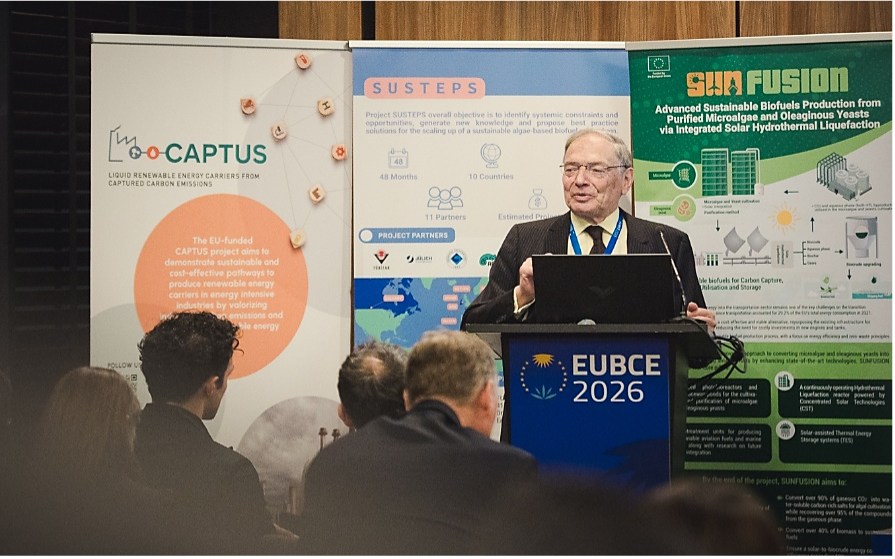
Using the SAF Policy Map (February 2025), Dr. Maniatis presented an overview of policy approaches to sustainable aviation fuels worldwide. He noted that, while the EU and the US are currently the only jurisdictions with SAF-specific legislation in force, mandates are under development in Brazil and India, and countries including Canada, China, South Korea, Japan, and several Southeast Asian nations are advancing SAF-related targets and strategies. While addressing the EU’s regulatory framework for SAF, Dr. Maniatis highlighted the ReFuelEU Aviation regulation.
This sets out a pathway for the blending of sustainable aviation fuels, rising from 2% in 2025 to 70% by 2050. The regulation also includes a dedicated e-SAF sub-mandate reaching 35% synthetic fuels by 2050.
“SAF complements energy efficiency and behavior change to decarbonize aviation. By 2050, decarbonization depends on commercializing and scaling new biofuel technologies and hydrogen-based fuels,” Dr. Kyriakos Maniatis noted, citing the IEA’s Net Zero Emissions scenario.
The single most cited reason investors step back is the fact that aviation biofuels currently cost three times the price of conventional kerosene. The path forward requires two parallel moves. First, a clearer and more stable European industrial strategy with dedicated funding and regulatory support for the e-fuels industry is needed. Secondly, there must be a sustained long-term commitment to scaling e-fuels. They are regarded as a potentially sustainable and scalable SAF pathway, but they need substantial long-term investment for large-scale deployment.
HIGH-LEVEL ROUNDTABLE ON SAF AND ADVANCED BIOFUELS
The roundtable brought together six experts from CINEA, Industry and Academia to discuss recent developments, future outlooks, and policy considerations related to advanced sustainable fuels. The discussions focused on identifying critical gaps that need to be addressed to de-risk emerging technologies, both technically and commercially, thereby supporting their successful deployment and market uptake.
“Public policies need to support demand and supply at the same time. Leveraging private funds and the energy industry that is leading SAF and marine biofuels development is primordial to accelerating deployment at the required scale,” Dr. Nikolaos Tsongidis, Centre for Research and Technology Hellas (CERTH) said.
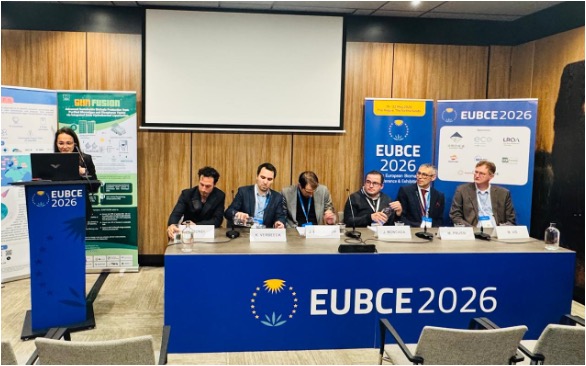
The following key takeaways were drawn from the panel discussion:
- SAF must be reframed as energy security and aviation resilience issue, not only as climate solution.
- Stable policy, demand-side mandates, supply-side support, and credible feedstock strategies must advance together. One single lever is not enough.
- The current EU framework is complex and unstable, generating investor uncertainty that slows deployment.
- High costs, global competition for residues such as used cooking oil, limited sustainable feedstocks, and fuel producers hesitating to invest in new processes remain the dominant barriers to scale.
- Biofuels, e-fuels, and biomass supply are complementary pathways. Shared infrastructure and the integration of biogenic CO₂ and green hydrogen strengthen the case for both.
- Europe holds significant biomass potential. But it requires clear, stable, and pragmatic regulation.
- There is no perfect solution: technological complementarity and dedicated support mechanisms for transitional stages and first-of-a-kind projects are essential to de-risk the sector.
BEYOND TECHNOLOGY: WINNING PUBLIC TRUST FOR ADVANCED BIOFUELS
The energy transition will not be decided in laboratories or boardrooms alone. As advanced biofuels from algae, lignocellulosic biomass, and other next-generation feedstocks move closer to commercial scale, they are expected to play a key role in powering aviation through sustainable aviation fuel and decarbonizing shipping with cleaner marine fuels. Public trust has become almost as critical as feedstock yields or production costs. Communities living near cultivation sites, biorefineries, or fuel distribution infrastructure hold real influence over whether scale-up happens, and at what pace.
In the session, Chiara Monacchini from the University of Genoa presented the results of a social acceptance analysis designed by CAPTUS in collaboration with SUSTEPS, examining how communities perceive these technologies, what drives acceptance or resistance, and how transparent governance can build the social license needed for deployment.
“The audience reflected the weight of the findings: social acceptance is no longer a soft consideration at the margins of the energy debate. Broad stakeholder engagement is needed to ensure public support and facilitate market uptake,” added Dr. Monique Bernardes Figueirêdo, CIRCE Centro Tecnológico.
THREE PROJECTS, THREE PATHWAYS TO SUSTAINABLE TRANSPORTATION FUELS
The successful workshop at EUBCE 2026 highlighted the importance of cross-sector collaboration in overcoming technological, economic and regulatory barriers to the large-scale deployment of sustainable fuels. Together, CAPTUS, SUSTEPS and SUNFUSION showcased the complementary pathways and technologies being developed across Europe to advance sustainable fuels, spanning carbon capture and utilization, algae-based fuel production, renewable hydrogen integration and solar-driven conversion technologies.
“The transition to sustainable fuels is not only an environmental challenge; it is also an opportunity to strengthen European energy sovereignty. Biofuels and carbon utilization pathways should be considered tools to support European industrial competitiveness,” concluded Dr. Abdullah Turan, TÜBİTAK Marmara Research Center.
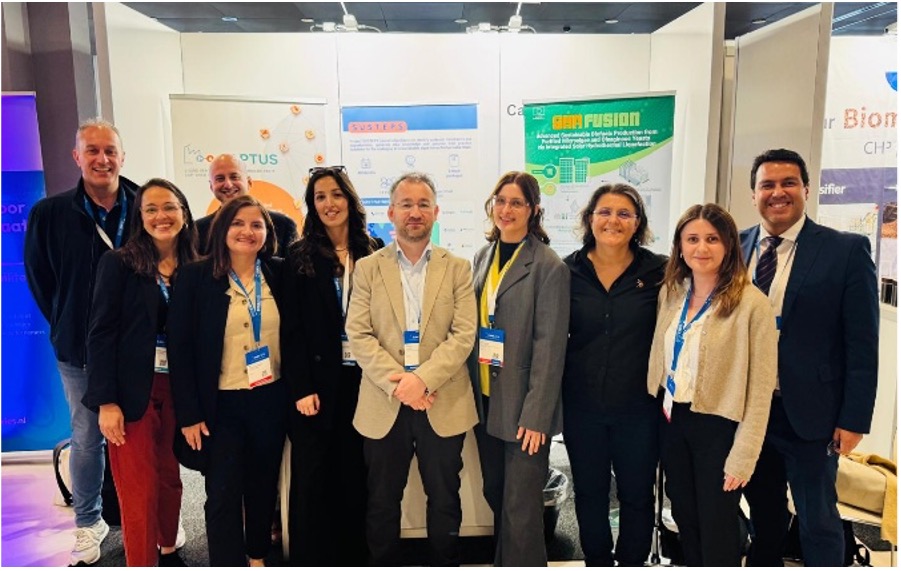
The project collaboration is part of the broader SUSTAFUELS Cluster, which unites ten leading Horizon Europe projects working to accelerate the development and deployment of advanced, algae-based sustainable fuels.
Find the full presentation deck of Dr. Maniatis here. The full conference proceedings will be published on the EUBCE website in September, allowing interested stakeholders to access the detailed discussions and presentations.
CAPTUS is developing pathways for producing renewable energy carriers from CO₂ captured from industrial flue gases, creating integrated solutions that combine carbon capture, renewable electricity and sustainable fuel production to support Europe’s net-zero ambitions.
Project Coordinator
CIRCE Technology Centre
E-Mail: captus@fcirce.es
https://www.linkedin.com/in/captus-project-94b01829b/
SUSTEPS is advancing the sustainable production of advanced biofuels, including sustainable aviation fuels, from microalgae. Through an innovative biorefinery approach, the project integrates wastewater utilisation, flue-gas-derived CO₂, green hydrogen and side-stream valorisation to improve sustainability and economic viability.
Project Coordinator
TÜKIYE BILIMSEL VE TEKNOLOJIK ARASTIRMA KURUMU (TÜBITAK)
E-Mail: abdullah.turan@tubitak.gov.tr
https://www.linkedin.com/company/susteps/
SUNFUSION is pioneering solar-powered biofuel production by converting microalgae and oleaginous yeasts into advanced biofuels using concentrated solar thermal technologies. Its innovative approach aims to achieve highly efficient, zero-emission biofuel production while enabling decentralized renewable energy solutions.
Project Coordinator
Centre for Research and Technology – Hellas (CERTH)
E-Mail: ntsongid@certh.gr
One thought on “CAPTUS, SUSTEPS and SUNFUSION Join Forces at EUBCE 2026 to Advance the Future of Sustainable Biofuels in Europe”